
OKRs for Product Teams: Building What Users Actually Need
 Leemu
Leemu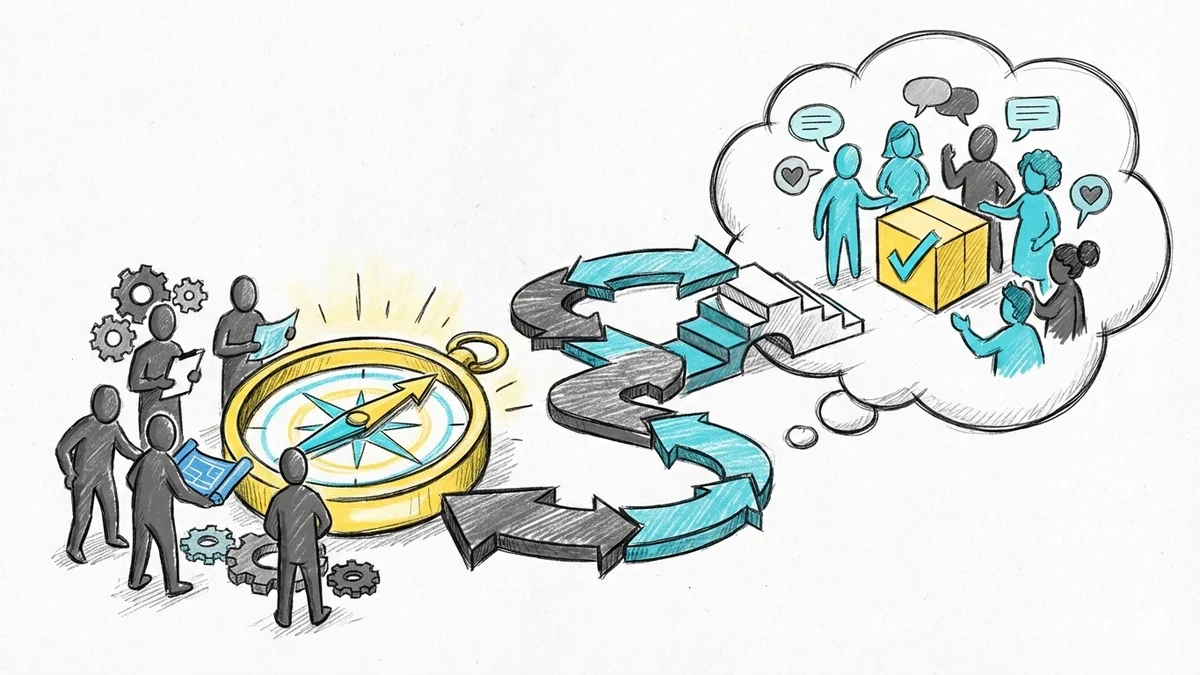
OKRs for Product Teams: Building What Users Actually Need
Meta Description: Master OKRs for product management and development. Learn to set outcome-focused objectives that drive user value, not just feature delivery.
Keywords: product OKRs, product management goals, product development OKRs, outcome-based product, feature delivery OKRs, product metrics
Introduction
Product teams face a constant tension: leadership wants features, users want solutions, and engineers want clarity. Feature lists grow while impact remains unclear. Teams ship constantly but can't prove they're making a difference.
OKRs offer a solution: outcome-focused goals that align everyone around user value, not just output. Instead of "Ship Feature X," product teams ask, "What outcome will Feature X create?"
This guide shows how to implement OKRs that transform product teams from feature factories to value engines.
The Output vs. Outcome Shift
The Feature Factory Problem
Traditional product "goals":
- Ship 10 features this quarter
- Complete the Q3 roadmap
- Reduce backlog by 50%
Problem: None of these guarantee user value. You can ship 10 features nobody uses, complete a roadmap that doesn't matter, and reduce a backlog of the wrong things.
The Outcome Mindset
OKR-driven product goals:
- Improve user activation by 30%
- Reduce time-to-value from 7 days to 1 day
- Increase feature adoption from 20% to 50%
Benefit: Teams focus on creating impact, not just shipping code.
Making the Shift
From: "Launch the new dashboard"
To: "Improve user decision-making through better data visibility"
- KR: 50% of users engage with dashboard weekly
- KR: User-reported decision confidence increases from 6 to 8
- KR: Time to find key information decreases by 60%
Product OKR Framework
Company → Product Alignment
Product OKRs should connect to company objectives:
Company Objective: Achieve product-market fit
Product Objective: Create a product users love and depend on
- KR: Achieve 40%+ "very disappointed" score
- KR: Increase weekly active users by 50%
- KR: Achieve NPS of 50+
The Product Trio
Product OKRs typically serve one of three purposes:
1. Acquisition: Getting new users
- Trial sign-ups
- Activation rates
- Time to first value
2. Engagement: Keeping users active
- Daily/weekly active users
- Feature adoption
- Session frequency
3. Retention: Preventing churn
- User retention rates
- Customer satisfaction
- Feature stickiness
Product OKR Examples
Acquisition-Focused OKRs
Objective: Make onboarding effortless
Key Results:
- Improve trial-to-paid conversion from 8% to 15%
- Reduce time to first value from 14 days to 3 days
- Achieve 90% onboarding completion rate (from 60%)
- Increase organic sign-ups by 40%
Engagement-Focused OKRs
Objective: Create a product users can't put down
Key Results:
- Increase DAU/MAU ratio from 20% to 40%
- Improve average session time from 5 to 12 minutes
- Achieve 70% adoption of core features (from 45%)
- Reduce "inactive user" rate by 50%
Retention-Focused OKRs
Objective: Build a product users never leave
Key Results:
- Improve 90-day retention from 60% to 80%
- Reduce voluntary churn from 5% to 2%
- Increase "would be very disappointed" score to 50%
- Achieve NPS of 60+
Platform/Foundation OKRs
Objective: Build a scalable, reliable platform
Key Results:
- Achieve 99.99% uptime (from 99.5%)
- Reduce p95 page load time to under 500ms
- Scale to handle 100K concurrent users
- Reduce critical bugs in production to zero
Innovation OKRs
Objective: Discover the next breakthrough feature
Key Results:
- Validate 3 product hypotheses with customer research
- Launch 2 experiments with 1000+ users each
- Identify 1 new feature with 70%+ intent-to-use
- Generate 5 patentable innovations
Setting Product OKRs
Step 1: Start with Problems
Don't start with solutions. Start with problems:
- What are users struggling with?
- Where are we losing users?
- What feedback do we keep hearing?
- Where is the data showing friction?
Step 2: Define Success
For each problem, define what success looks like:
- How will we know we've solved it?
- What metric will change?
- What behavior will we see?
Step 3: Set Ambitious Targets
Push beyond incremental improvement:
- Not "improve conversion by 5%"
- Try "double conversion rate"
Step 4: Connect to Strategy
Ensure alignment:
- Does this support company objectives?
- Is this the highest-impact focus?
- Do we have resources to succeed?
Step 5: Validate with Data
Before committing:
- Do we have baseline data?
- Can we measure progress?
- Is the goal achievable?
Product OKRs by Team Structure
Feature Teams
Teams owning specific product areas:
Team: Payments
Objective: Create frictionless payment experience
Key Results:
- Reduce checkout abandonment from 40% to 20%
- Improve payment success rate from 92% to 98%
- Launch 3 new payment methods with 10%+ adoption
- Reduce payment-related support tickets by 50%
Platform Teams
Teams supporting other teams:
Team: Platform/Infrastructure
Objective: Enable rapid, reliable product development
Key Results:
- Reduce deployment time from 4 hours to 15 minutes
- Achieve 99.99% API availability
- Reduce P1 incidents by 75%
- Enable 10 deploys per day (from 2)
Growth Teams
Teams focused on user acquisition and activation:
Team: Growth
Objective: Accelerate user acquisition and activation
Key Results:
- Increase monthly sign-ups from 5K to 15K
- Improve activation rate from 30% to 50%
- Reduce CAC by 25%
- Grow organic acquisition by 100%
Experience Teams
Teams focused on user experience:
Team: UX
Objective: Create delightful user experiences
Key Results:
- Achieve System Usability Scale score of 80+
- Reduce time-on-task for key workflows by 40%
- Achieve 95% positive feedback on redesigned flows
- Reduce UX-related support tickets by 30%
The Product OKR Process
Quarterly Planning
Week -3: Review previous quarter
- What did we learn?
- What metrics changed?
- What should we focus on?
Week -2: Draft objectives
- Problem identification
- Outcome definition
- Target setting
Week -1: Align and finalize
- Cross-team coordination
- Dependency identification
- Resource confirmation
Weekly Product Review
Format (30-60 minutes):
- Metric review: How are KRs trending?
- Progress updates: What shipped? What learned?
- Blockers: What's in the way?
- Priorities: What's most important this week?
Continuous Discovery
OKRs don't replace ongoing research:
- User interviews continue
- Data analysis continues
- Experiments continue
OKRs provide focus; discovery provides direction.
Balancing Delivery and Discovery
The Discovery/Delivery Ratio
Product teams must balance:
- Discovery: Learning what to build
- Delivery: Building what you've learned
Typical allocation:
- 70-80% delivery (building toward OKRs)
- 20-30% discovery (learning for future OKRs)
Using OKRs for Discovery
Objective: Validate next product direction
Key Results:
- Conduct 50 user research sessions
- Test 5 prototypes with target users
- Identify 3 validated problem-solution fits
- Define requirements for top opportunity
Product OKRs and Engineering
Collaboration, Not Handoff
Product OKRs aren't "product tells engineering what to build."
Better approach:
- Product + Engineering co-create OKRs
- Engineering contributes to outcome definition
- Teams share ownership of results
Technical Debt in OKRs
Technical work can be in OKRs when tied to outcomes:
Instead of: "Reduce technical debt"
Try: "Improve engineering velocity"
- KR: Reduce bug fix time by 50%
- KR: Increase deployment frequency by 3x
- KR: Reduce time from idea to production by 40%
Reliability and Performance
Infrastructure improvements as outcomes:
Objective: Deliver rock-solid product reliability
Key Results:
- Achieve 99.99% uptime
- Reduce mean time to recovery to under 30 minutes
- Eliminate all P1 security vulnerabilities
- Improve core web vitals to "Good" for all pages
Common Product OKR Pitfalls
Pitfall 1: Output OKRs
Problem: "Ship Feature X" as a Key Result
Fix: What outcome will Feature X create?
Pitfall 2: Too Many OKRs
Problem: 5 objectives with 5 KRs each
Fix: 1-3 objectives maximum. Focus is power.
Pitfall 3: Vanity Metrics
Problem: KRs that look good but don't indicate value
Fix: Choose metrics that reflect user value
Pitfall 4: No Baseline
Problem: Setting targets without knowing current state
Fix: Measure baseline before setting targets
Pitfall 5: Set and Forget
Problem: Quarterly OKRs, quarterly review
Fix: Weekly progress tracking and discussion
Pitfall 6: Ignoring Quality
Problem: All OKRs about features, none about quality
Fix: Include reliability, performance, and stability
Measuring Product Success
Quantitative Metrics
Acquisition:
- Sign-ups, trials, activations
- Conversion rates
- Time to value
Engagement:
- DAU, WAU, MAU
- Session frequency and duration
- Feature adoption
Retention:
- Day 1, 7, 30, 90 retention
- Churn rate
- Resurrection rate
Satisfaction:
- NPS, CSAT
- Feature ratings
- Support ticket volume
Qualitative Metrics
User sentiment:
- Interview feedback themes
- Support ticket sentiment
- Review and rating content
Sean Ellis Test:
"How would you feel if you could no longer use this product?"
- Very disappointed (target: 40%+)
- Somewhat disappointed
- Not disappointed
Tools for Product OKRs
OKR Management
- Leemu OKR
- Lattice
- Perdoo
- Weekdone
Product Analytics
- Amplitude
- Mixpanel
- Heap
- Pendo
User Research
- UserTesting
- Maze
- Dovetail
- Lookback
Integration
Connect analytics to OKR tools for automatic progress tracking.
Conclusion
Product OKRs transform teams from feature factories to value engines. By focusing on outcomes instead of outputs, product teams can prove their impact and ensure they're building what users actually need.
The key is discipline: resist the urge to measure features shipped. Instead, measure the outcomes those features create. Ask not "What will we build?" but "What will change as a result?"
That's the power of outcome-focused product OKRs.
Related Articles:
- OKRs for SaaS Companies: Driving Growth and Retention
- How to Write Effective Objectives That Inspire Action
- The Anatomy of a Great Key Result
Ready to align your team with OKRs?
Start tracking your objectives and key results with Leemu. Free to get started, no credit card required.
Get Started Free

