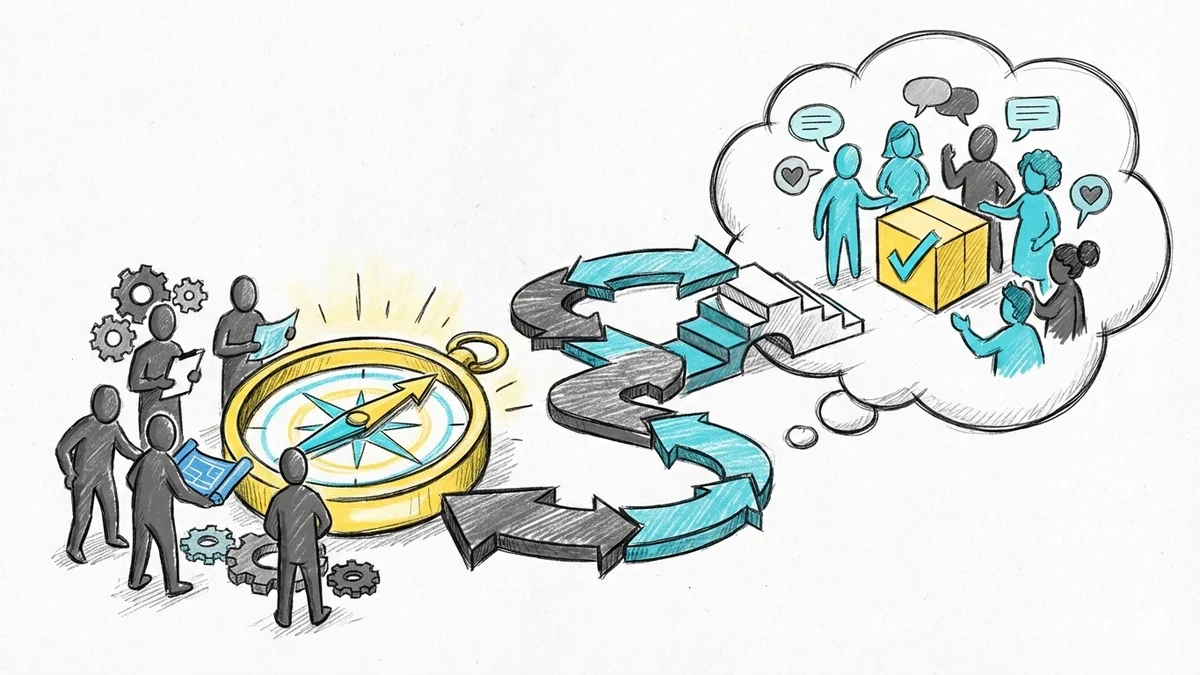


OKRs for Nonprofits: Mission-Driven Goal Setting
Meta Description: Learn how to implement OKRs in nonprofit organizations. Adapt the framework for mission-driven work with examples from healthcare, education, and social impact.
Keywords: nonprofit OKRs, mission-driven goals, social impact OKRs, NGO goal setting, nonprofit strategy, impact measurement
Introduction
Nonprofits face a unique challenge: how do you measure success when your goal isn't profit? How do you set ambitious targets when outcomes are complex and long-term?
OKRs offer a powerful framework for mission-driven organizations. They bring focus, alignment, and measurability without reducing everything to dollars and cents. Organizations like the Gates Foundation, charity: water, and hundreds of nonprofits use OKRs to maximize their impact.
This guide shows how to adapt OKRs for nonprofit success.
Why OKRs Work for Nonprofits
The Measurement Challenge
Nonprofits often struggle with measurement:
- Impact is long-term and complex
- Outcomes are harder to quantify than revenue
- Success has multiple dimensions
- Attribution is difficult
OKRs address this by encouraging thoughtful metric selection—what can we measure that indicates progress toward our mission?
The Focus Challenge
Mission-driven organizations face unlimited need:
- So many problems to solve
- So many people to help
- Limited resources to deploy
OKRs force prioritization—which outcomes matter most right now?
The Alignment Challenge
Nonprofits often have diverse stakeholders:
- Board members
- Donors
- Staff
- Volunteers
- Beneficiaries
- Partners
OKRs create shared language and visible priorities.
Adapting OKRs for Mission-Driven Work
From Revenue to Impact
For-profit: Revenue growth is the ultimate metric
Nonprofit: Impact metrics replace revenue
Impact metrics vary by mission:
- Lives improved
- Students educated
- Acres conserved
- Policies changed
- Communities served
From Customers to Beneficiaries
Reframe language:
- "Customers served" → "Beneficiaries reached"
- "Customer satisfaction" → "Beneficiary outcomes"
- "Customer retention" → "Continued engagement"
From Efficiency to Effectiveness
Balance both:
- Effectiveness: Are we achieving impact?
- Efficiency: Are we using resources wisely?
The Theory of Change Connection
Your OKRs should connect to your theory of change:
Theory of Change: If we provide job training (activity), people will gain skills (output), leading to employment (outcome), resulting in economic mobility (impact).
OKR Connection:
- Activities → What we do (not OKR focus)
- Outputs → Easy to measure, good for tracking
- Outcomes → Good Key Results
- Impact → Ultimate objective, may span years
Nonprofit OKR Categories
1. Impact OKRs
Direct mission achievement:
Example (Education Nonprofit):
Objective: Dramatically improve educational outcomes in underserved communities
Key Results:
- Increase student reading proficiency from 45% to 65% across served schools
- Reduce dropout rates from 20% to 12%
- Improve college enrollment from 35% to 50%
2. Capacity OKRs
Building organizational strength:
Example:
Objective: Build organizational capacity for scaled impact
Key Results:
- Grow annual budget from $2M to $4M
- Diversify funding (reduce dependence on any single source below 30%)
- Recruit and train 50 new volunteers
- Achieve 90%+ staff retention
3. Operational OKRs
Improving how you work:
Example:
Objective: Create efficient, high-quality program delivery
Key Results:
- Reduce program delivery cost per beneficiary by 20%
- Achieve 95% beneficiary satisfaction
- Standardize program model for replication
- Reduce administrative overhead from 25% to 18%
4. Advocacy OKRs
Changing systems and policies:
Example:
Objective: Advance policy change that creates systemic impact
Key Results:
- Secure passage of 3 target pieces of legislation
- Build coalition with 50+ organizational partners
- Generate 10,000 constituent contacts to legislators
- Achieve 15 earned media placements
5. Fundraising OKRs
Securing resources for mission:
Example:
Objective: Build sustainable funding foundation
Key Results:
- Raise $3M in annual donations
- Increase monthly donors from 200 to 500
- Secure 2 new major gifts ($100K+)
- Achieve 70% donor retention rate
Nonprofit OKR Examples by Sector
Healthcare Nonprofit
Objective: Expand access to quality healthcare
Key Results:
- Serve 5,000 patients (from 3,000)
- Reduce patient wait time to under 30 minutes
- Achieve 90%+ patient satisfaction
- Launch mobile clinic serving 500 additional patients
Environmental Organization
Objective: Protect critical ecosystems
Key Results:
- Conserve 10,000 additional acres of habitat
- Reduce pollution levels by 30% in target watershed
- Engage 50,000 people in conservation activities
- Pass 3 environmental protection ordinances
Education Nonprofit
Objective: Prepare students for success
Key Results:
- Improve math proficiency from 40% to 60%
- Graduate 90% of program participants on time
- Place 80% of graduates in post-secondary education
- Achieve 95% attendance rate in programs
Social Services Organization
Objective: Help families achieve stability
Key Results:
- House 200 homeless families
- Achieve 85% housing retention at 12 months
- Connect 500 individuals to employment
- Reduce food insecurity by 40% among served families
Arts & Culture Organization
Objective: Make arts accessible to all
Key Results:
- Reach 100,000 people through programs
- Serve 5,000 underserved youth
- Achieve 90%+ participant satisfaction
- Generate $500K in earned revenue
The Nonprofit OKR Process
Annual Planning
Connect to strategic plan:
- Review mission and strategic priorities
- Set annual impact targets
- Break into quarterly OKRs
- Align programs and departments
Board Integration
Engage board appropriately:
- Board reviews and approves annual OKRs
- Quarterly progress reports to board
- Board doesn't micromanage Key Results
Staff Engagement
Include staff in the process:
- Program staff provide frontline insight
- Team OKRs developed collaboratively
- All staff understand organization OKRs
Donor Communication
Share OKRs with donors:
- Transparency builds trust
- Progress updates demonstrate impact
- Clear connection between funding and outcomes
Measuring Nonprofit Impact
Choosing What to Measure
Not all impact is easily quantifiable. Choose metrics that:
- Are meaningful: Actually indicate impact
- Are measurable: Can be tracked reliably
- Are attributable: Can be connected to your work
- Are actionable: Can inform improvements
Output vs. Outcome Metrics
Outputs: What you produce
- Meals served
- Students enrolled
- Workshops conducted
Outcomes: Changes that result
- Nutrition improved
- Skills gained
- Behavior changed
Both matter, but outcomes are more important indicators of impact.
Long-Term vs. Short-Term
Some impact takes years to manifest. Handle this with:
Quarterly OKRs: Short-term outcomes and outputs
Annual OKRs: Medium-term outcomes
Multi-year goals: Long-term impact
Proxy Metrics
When ultimate impact is hard to measure, use proxies:
Ultimate goal: Reduce poverty
Proxy metrics: Employment rates, income levels, job placements
Common Nonprofit OKR Challenges
Challenge 1: "Our impact can't be measured"
Reality: Some aspects can be measured; others need proxies.
Solution: Focus on measurable indicators of progress. Accept imperfect measurement over no measurement.
Challenge 2: "We need flexibility for grant requirements"
Reality: Grants often have specific deliverables.
Solution: Align OKRs with grant requirements where possible. Keep OKRs strategic, grants operational.
Challenge 3: "We're too small for OKRs"
Reality: Small organizations benefit most from focus.
Solution: Start with 1-2 objectives. Keep process simple.
Challenge 4: "Board wants different metrics"
Reality: Boards often focus on financial sustainability.
Solution: Balance impact OKRs with capacity OKRs. Educate board on both.
Challenge 5: "Staff resist measurement"
Reality: Some fear measurement will be punitive.
Solution: Frame OKRs as learning tools, not performance evaluation.
OKRs and Grant Reporting
Aligning OKRs with Grants
Many grants require specific metrics. Integrate these:
Option 1: Grant deliverables become Key Results
Option 2: OKRs encompass but aren't limited to grant requirements
Option 3: Separate operational metrics (grants) from strategic OKRs
Using OKRs in Grant Applications
OKRs demonstrate:
- Clear theory of change
- Measurable targets
- Track record of achievement
- Strategic focus
Tools for Nonprofit OKRs
Budget Considerations
Nonprofits need affordable options:
- Free: Google Sheets, Notion free tier
- Low-cost: Asana, Monday.com nonprofit pricing
- Purpose-built: Leemu OKR (often offers nonprofit pricing)
Existing Systems
Integrate with what you have:
- Program databases
- Donor management systems
- Grant tracking tools
Case Study: Nonprofit OKR Journey
Year 1: Foundation
Situation: Regional food bank, $3M budget, no formal goal-setting
Approach:
- Started with 2 organizational OKRs
- Trained leadership team
- Quarterly reviews
First OKRs:
Objective 1: Increase food access in target communities
Key Results:
- Distribute 5M pounds of food (from 4M)
- Serve 25,000 unique individuals
- Reduce food insecurity score from 3.2 to 2.8
Objective 2: Build sustainable operations
Key Results:
- Diversify funding (no source > 25%)
- Recruit 100 new volunteers
- Achieve 85% staff retention
Year 2: Expansion
Extended OKRs to programs:
- Each program has aligned OKRs
- Cross-functional OKRs for major initiatives
- Board receives quarterly OKR reports
Year 3: Maturity
OKRs embedded in culture:
- Grant proposals reference OKR progress
- Donors receive OKR-based impact reports
- Staff use OKRs for personal development
Impact: 40% increase in food distributed, 50% increase in funding, higher staff engagement
Conclusion
OKRs help nonprofits do what they do best—create impact—more effectively. The framework doesn't replace mission-driven purpose with cold metrics. Instead, it provides structure for translating purpose into action.
Start simple. Focus on outcomes that matter. Build measurement into your culture. Use OKRs to communicate impact to donors, boards, and stakeholders.
Your mission is too important for vague goals and unfocused effort. OKRs give you the framework for maximum impact.
Related Articles:
- What Are OKRs? A Complete Beginner's Guide
- Common OKR Mistakes and How to Avoid Them
- Building a Culture of Transparency with OKRs
Ready to align your team with OKRs?
Start tracking your objectives and key results with Leemu. Free to get started, no credit card required.
Get Started Free